Your LYFGENIA™ FAQs answered
Get to know some of the commonly asked questions about LYFGENIA.
Jump to topics on page:
Sickle Cell Disease & How LYFGENIA WorksStudies & Eligibility
Safety
Treatment Process, Insurance, and Cost
Jump to topics on page:
Sickle Cell Disease & How LYFGENIA Works Studies & Eligibility Safety Treatment Process, Insurance, and CostJump to topics on page:
Sickle Cell Disease & How LYFGENIA WorksStudies & Eligibility
Safety
Treatment Process, Insurance, and Cost
Sickle cell disease is caused by a [[gene]] mutation that produces abnormal hemoglobin. Repeated blockages and damage to the blood vessels over time can prevent your organs and tissues from getting the oxygen they need and can cause [[vaso-occlusive events (VOEs)]]
Explore more about sickle cell diseaseYes. LYFGENIA is a [[gene addition therapy]]. It uses a viral vector to add genetic material directly to your stem cells, helping your body produce functional [[red blood cells]].
Explore more about LYFGENIANo. LYFGENIA is a [[gene]] therapy treatment that uses your body’s own stem cells.
Learn more about how LYFGENIA worksLYFGENIA works at the genetic level to help your body make functional red blood cells, so that you can potentially decrease or stop experiencing [[vaso-occlusive events (VOEs)]].
Explore how LYFGENIA worksNo. LYFGENIA cannot cause HIV infection because parts of the HIV virus responsible for causing the infection have been removed from the vector that LYFGENIA uses.
Dive deeper into vectors & HIVDuring the decision-making process, you’ll likely have questions. We’ve created a list to keep handy at your next doctor visit.
See the questionsLYFGENIA is a [[gene]] therapy indicated for individuals with sickle cell disease who are 12 years or older and have a history of [[vaso-occlusive events (VOEs)]].
Learn more about LYFGENIAYes, LYFGENIA was approved by the FDA in December 2023.
Take a look at LYFGENIA resultsLYFGENIA is for individuals with sickle cell disease who are 12 years or older.
Learn more about LYFGENIABefore treatment, people living with sickle cell disease and their healthcare providers will work together to help consider whether LYFGENIA is right for them and if they’re eligible for LYFGENIA.
Talk to your doctorAlmost all individuals treated with LYFGENIA no longer experience [[vaso-occlusive events (VOEs)]]. 88% of individuals (28/32) did not experience any vaso-occlusive events (VOEs). 94% of individuals (30/32) did not experience any [[severe vaso-occlusive events (sVOEs)]].
See the results for yourselfPatients treated with LYFGENIA have developed blood cancers. Treatment with LYFGENIA may increase your risk of developing blood cancer. Blood cancer can develop many years after treatment with LYFGENIA. Blood cancer can be life-threatening and/or cause death. Because of the risk of blood cancer, you should talk to your doctor about the benefits and risks of LYFGENIA, and about your treatment options. Your doctor may evaluate if you have risk factors that increase your chances of developing blood cancer after LYFGENIA.
Because of the risk of cancer, it is important for you to be monitored at least every 6 months for a minimum of 15 years after LYFGENIA. Monitoring will include blood tests that measure your blood cell counts and evaluation of the blood cells where the gene product is present with specialized tests. If these tests are abnormal, additional testing may be recommended by your doctor, which might include more frequent blood tests and a bone marrow evaluation, which can tell your doctor if a blood cancer is developing.
Blood cancer may cause no symptoms, or symptoms can be general. You or your caregiver should call your healthcare provider right away for any of these signs or symptoms:
- Abnormal bruising or bleeding (including nosebleed)
- Blood in urine, stool, or vomit
- Coughing up blood
- Severe headache
- Unusual stomach or back pain
- Fever (100.4°F/38°C or higher)
- Swollen glands
- Abnormal tiredness
If you are diagnosed with a cancer, have your treating physician contact bluebird bio at 1-833-999-6378.
You may experience side effects associated with other medicines administered as part of the LYFGENIA treatment regimen. Talk to your physician regarding those possible side effects. Your healthcare providers may give you other medicines to treat your side effects. It is important that you or your caregiver tell your healthcare providers that you have received LYFGENIA.
Understand the risksLike many treatments, LYFGENIA has potential side effects. The most common ones are low blood pressure and hot flush on the day of treatment and blood cancer and a longer time for platelets to recover following treatment. Because of the risks, you should talk to your doctor about the benefits and risks of LYFGENIA, and about your treatment options.
Understand the risksUnfortunately, there are no available data about LYFGENIA and pregnancy, but there are risks for pregnant individuals and there are risks associated with conditioning on pregnancy and fertility. Make sure to consult your doctor if you’re pregnant or considering getting pregnant.
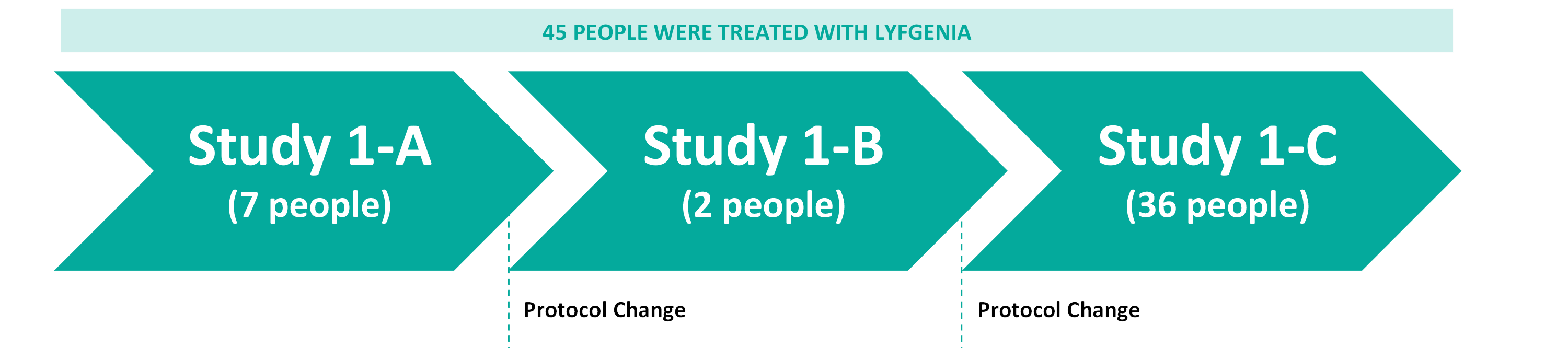
The LYFGENIA clinical trial (Study 1) protocol evolved over time as a result of improvements to the cell collection and LYFGENIA creation process. There were three parts to Study 1 in the LYFGENIA clinical trials—Study 1-A, Study 1-B, and Study 1-C. Protocol changes happened between Study 1-A and 1-B and between Study 1-B and Study 1-C. The cell collection and LYFGENIA creation process that occurred in Study 1-C is the same process that takes place in the FDA-approved version of LYFGENIA. Individuals treated with an earlier version of LYFGENIA developed blood cancers.
If you’re considering LYFGENIA, you should start by talking to a doctor. Looking for more resources about LYFGENIA? You can find them with my bluebird support by contacting a [[Patient Navigator]].
Connect with a Patient NavigatorLYFGENIA is a one-time [[infusion]] that can only be administered at a [[Qualified Treatment Center (QTC)]] after a hematologist provides a referral.
Take a look at the LYFGENIA journeyYour journey may look different depending on your circumstances, unique to you and your care team at the [[Qualified Treatment Center (QTC)]].
Learn more about the treatment processLYFGENIA is only available at a [[Qualified Treatment Center (QTC)]]. A QTC is a specialized hospital qualified to administer a bluebird bio [[gene]] therapy. Each LYFGENIA QTC has been carefully selected based on their expertise in areas such as transplant, cell, and gene therapy.
Find a QTCIf you’re interested in a [[Qualified Treatment Center (QTC)]], take a look at our QTC locator tool. This is where you can find the latest list. We’re also activating more centers, so please continue to check for updates.
Find a QTCChemotherapy is given to condition or make room for [[stem cells]] in your bone marrow for [[gene]] therapy or stem cell transplant. Some form of chemotherapy is required for all transplant options—whether it is gene therapy or donor stem cell transplant.
Understand the treatment processIt’s possible. Because chemotherapy is used during the [[conditioning]] process, [[gene]] therapy comes with a risk of infertility. It is important to learn about these risks and discuss them with your doctor, and, if needed, discuss any options for fertility preservation, such as freezing eggs or sperm.
Learn more about the processYour [[Patient Navigator]] at my bluebird support can help you explore your coverage options and what out-of-pocket costs you may be responsible for, including copays. Patient Navigators can also help identify potential sources of support for eligible and uninsured individuals.
Connect with a Patient Navigator:
Send an email: mybluebirdsupport@bluebirdbio.com
Call: 1-833-888-NEST (6378)
Learn more about my bluebird supportmy bluebird support can help support you when exploring your benefits. This includes coverage options. my bluebird support can also work closely with your health insurance provider and your doctor’s office staff by offering guidance and answers to coverage questions.
Find support